
Actinic Keratoses
TREAT PRECANCEROUS SUN DAMAGE BEFORE IT PROGRESSES.
A rough, scaly patch that won't smooth out no matter how much you moisturize is often the first sign of an actinic keratosis, a precancerous growth caused by cumulative sun exposure. Left untreated, actinic keratoses inevitably progress to squamous cell carcinoma. So early detection and treatment is key to avoiding skin cancer.
OUR APPROACH
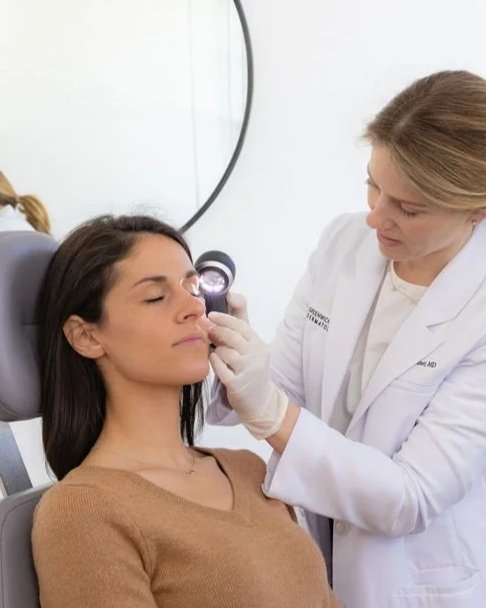
Our board-certified dermatologists identify and diagnose actinic keratoses on exam, often using dermoscopy to detect lesions the naked eye would miss, We treat actinic keratoses before they have the chance to progress. An actinic keratosis treatment is built around clearing both the visible lesion and the surrounding sun-damaged skin where new ones tend to form. We build a treatment plan around how many lesions are present and how widespread the sun damage is, combining targeted removal of individual lesions with broader field treatment when needed.
FAQS
What does an actinic keratosis look like?
Typically a rough, dry, scaly patch, often pink, red or skin-colored, ranging from the size of a pinhead to larger than a quarter. It's frequently easier to feel than to see, and commonly appears on the face, ears, scalp, forearms and backs of the hands.
How is an actinic keratosis different from skin cancer?
Actinic keratosis is precancerous, meaning it has the potential to develop into squamous cell carcinoma if left untreated.
What is photodynamic therapy, and how many sessions does it take?
A photosensitizing solution is applied to the skin and activated with a specific light source, targeting sun-damaged precancerous cells while sparing healthy tissue. Most patients need one to two sessions, spaced several weeks apart, and it's particularly effective for widespread sun damage rather than a single isolated spot.
Can an actinic keratosis come back after treatment?
Yes, particularly in areas with significant cumulative sun exposure. Because the underlying sun damage extends beyond any single visible lesion, ongoing sun protection and periodic skin checks are part of long-term management.