
Skin Lesions
CAREFUL EVALUATION OF EVERY MOLE, BUMP AND GROWTH.
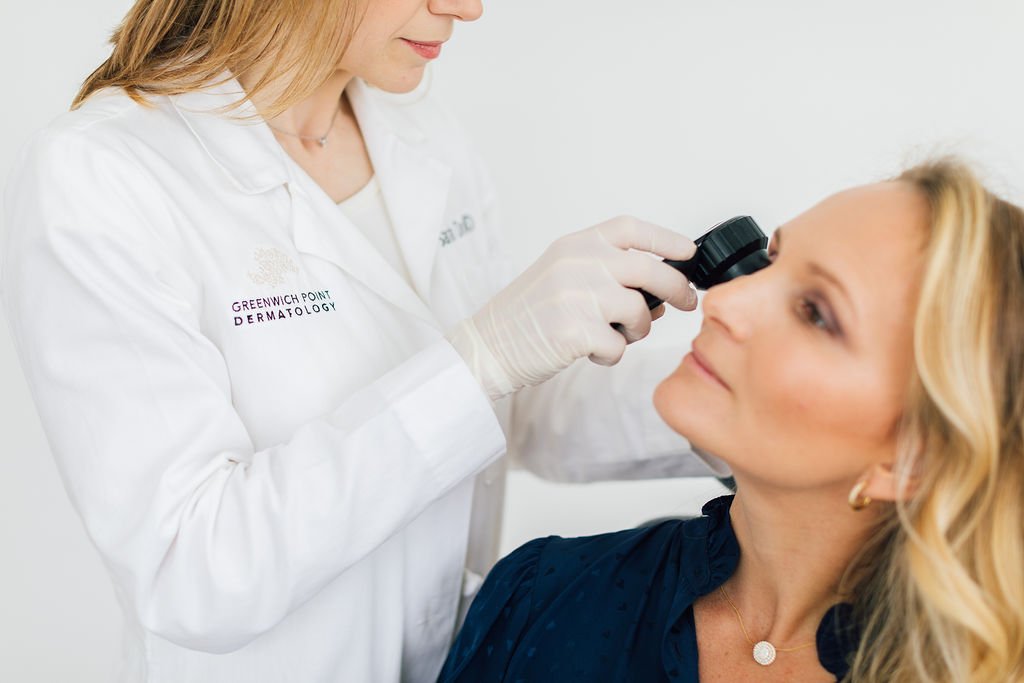
Our board-certified dermatologists evaluate every skin lesion with attention to detail and precision, combining dermoscopy technology and biopsy when warranted. Depending on whether the growth is benign or malignant, treatment or removal options are discussed before being performed.
OUR APPROACH
Skin growths come in all shapes and sizes: moles, skin tags, seborrheic keratoses, small cysts. Most are benign and harmless, but a small number are cancerous, and the two can look similar enough that telling them apart takes more than a glance in the mirror. Our board-certified dermatologists examine new, changing or concerning skin lesions with cutting-edge dermoscopy. Sometimes we recommend and perform a biopsy when a skin growth has suspicious features. Skin lesion evaluation in Greenwich, CT starts with our expert assessment to determine if the treatment involves removal, monitoring or reassurance.
TREATMENT RECOMMENDATIONS
Skin Cancer Screening
Biopsy & Diagnosis
Cryotherapy Removal
FAQS
Can benign growths like skin tags or seborrheic keratoses be removed for cosmetic reasons?
Yes. Once a lesion is confirmed benign, removal for cosmetic improvement is a straightforward in-office procedure, typically using cryotherapy, laser treatment or a minor excision, depending on the type and location.
How do I know if a mole needs to be checked?
You should use the “ABCDE rule” as a guide: Asymmetry, Border (irregular), Color (variation), Diameter (larger than a pencil eraser), and Evolution (change over time). If any one of these rules apply, or if you have a new lesion that simply looks different from your others, you should schedule a skin exam immediately.
How often should I get a full skin check?
Our board-certified dermatologists recommend an annual skin cancer screening, with more frequent visits recommended for those with a personal or family history of skin cancer, significant sun exposure, or a high number of moles.
What happens during a biopsy?
A small sample of the lesion, or the entire growth, is removed under local anesthesia and sent to a lab for analysis. Most biopsies take only a few minutes in the office, with results typically available within a week.